Wednesday, August 10, 2011

Moving Experiences

As I documented in my first blog postings earlier this year, my darling wife and I conducted an extensive apartment search upon moving to Ramallah.  We systematically dismissed more than 40 options.  Like Goldilocks, we found this one to be too big, that one to be too small, etc.  We finally found one that felt 'just about right,' and that's where we've been living since February.  And while we continued to feel our apartment has some very nice features, it lacks good outdoor space.  We have a balcony that is good for drying clothes, but not conducive to extensive hanging out.

So, we've been keeping our eyes open for a housing option that offers suitable outdoors space--either a garden or a large balcony.  A couple of weeks ago, we thought we had found a great option--a whole house at a decent price with a good garden.  The first downside was its location, but some strange behavior by the landlord took the house out of contention for us.

However, when talking to our current landlord we learned that he had another apartment available that had a garden area.  Last Saturday, we saw the apartment and decided it would be a good move for us.  And we still have plenty of room for visitors.  A teaser photo of the garden:


The garden includes various fruit and nut trees, including: apple, lemon, plum, pomegranate, walnut, almond, plus grape vines...and space for a small vegetable garden.  We can easily host a bbq or just sit in the shade reading, playing cards, or napping.

The inside aint bad either:

Two bedrooms, two bathrooms, office, dining area, family room, big kitchen, plenty of storage space.

So now we're knee deep in boxes and getting ready to move this coming weekend.  My darling (underemployed) wife is doing a fantastic job packing...literally, right now, while I blog.  I'm hoping to move at least some of our items using my bike and trailer, which I used extensively in Baltimore but haven't put to use here, yet.

In other moving news, I have tenants in my house in Baltimore (finally).  This is welcome news, especially after several months of sitting empty.

So that's the update.  Wish us luck on the move!

Saturday, July 30, 2011

On the eve of Ramadan

I am not a Muslim.  I am a non-practicing agnostic who was raised in a loving and supportive household by two wonderful  Roman Catholic parents whose faith I admire but do not fully understand and cannot replicate.  It is through no fault of theirs that I am not a more religious person and although they would be thrilled to hear that I faith has become a central part of my life, they show great patience each time they discover this is not the case.  Despite an inability to integrate the rituals of religion and deep faith into my life, I try my best to live a decent life, to help and respect my friends, family, and worldly neighbors, and to generally do my part to leave things in a better state than I found them in.

But back to the first words of this post and its title.  I am not a Muslim, so I am not the best person to write about the month of Ramadan.  But since Ramadan dominates most conversations I have these days and since this is my blog, that will be the topic of this week's blog.

Ramadan will most likely start on what we consider to be August 1, but on the date that the Muslim calendar would call the first day of Ramadan (no coincidence).  Since Islam follows a lunar calendar, the new month starts when the new moon appears.  This year, most people are predicting a sliver of moon will be seen in the sky on August 1, thus triggering 29-30 days of Ramadan.  However, it could start as early as July 31.  Whenever the moon first appears and the imam in Saudi Arabia declares it to be Ramadan, the following will also begin:

Fasting:
The most prominent and tangible aspect of Ramadan is fasting from sunrise to sunset.  Unlike in another religion with which I am familiar where fasting might mean abstaining from beef or chicken and hoarding instead on mounds of fried fish, in Islam fasting is taken very seriously.  No food.  No drink.  All day.  For 30 consecutive days.  This means that the first meal of the day is eaten before the sun rises and dinner (or iftar) is served in the evening.  The fast is generally broken with dates and water or juice so as not to stress the hungry body with a sudden influx of food but to introduce some hydration and calories to the system.  But soon thereafter, large meals are served.

Even for those of us who don't officially fast, Ramadan naturally brings sacrifices from food and drink.  Eating and drinking in public is highly frowned upon and the majority of food establishments aren't open during the daytime.  (Some restaurants even close for the entire month for major remodeling or maintenance projects.)  Thus, eating and drinking during the day needs to be well planned and done discreetly.

Winter time:
According to the British (and Palestinians), daylight savings time is called 'summer time' and standard time is called 'winter time.'  (Before I knew this, I thought I had observed an extreme display of hubris when I saw a headline that said Israel had decided to extend summer time into October.  As if they have the ability to alter seasonal shifts...)  Anyway, the Palestinian Authority recently announced that when Ramadan starts we will go back to winter time--the clocks will roll back one hour.  Jerusalem, however, which I can basically see from my apartment window, will stay on summer time.  So if I have a meeting in Jerusalem during Ramadan at 9am, I need to anticipate the one hour time warp that I will encounter 5 miles down the road.

Questionable productivity potential:
I don't like to write about work in this blog, but I will mention one small work-related thing here.  I am very interested to find out whether my ability to get things accomplished at work will increase or decrease during Ramadan.  Like other workplaces, we are reducing our official daily work hours by 1.5 hours.  I've been warned that some people and organizations use Ramadan as an excuse not to do much work.  This could be highly unfortunate if I'm relying on contributions or participation by others to help accomplish important tasks.  On the other hand, this could play to my advantage if it means fewer distractions and more opportunities to focus on tasks I can make progress on independently.  Either way, the work isn't going away--perhaps just the pressure to get it done on a tight timeline will be reduced.

----
And so that concludes my current Ramadan observations, other than to mention that this upcoming Ramadan could be very difficult for those observing the fast.  The long summer days will translate to more hours between sunrise and sundown and thus a longer period of fasting.  The hot August weather will mean dehydration is more likely.

Whether you're Muslim or not, and whether you're fasting or not, Unimpossible Life wishes you peace, love, and happiness over the coming weeks.

Until next time...

Sunday, July 24, 2011

Palestine Photoblog

Last week I promised my next blog would include a series of interviews with the Ramallah elite.  Alas, scheduling conflicts and technical problems have delayed the production of such a posting.  And I know my readers demand only the highest quality content, so rather than rush what should certainly be nominated for a Bloggy (or whatever award is given to excellence in blogging), I will wait until the finished product is at the standard you deserve.

Instead, I will share photos along with my wit and wisdom...


According to locally held beliefs, this innocent looking hill just north of the West Bank will be the main gathering spot on Judgement Day.


Delicious grape leaves - ready to wrap delightful treats.


A van in Nazareth loaded with other kinds of wrapping devices.


Even up close, it appears this flower is sprouting Cheetos.


The Sea of Galilee--calm, blue waters fed by the Jordan River from the north and a feeder to the Jordan River to the south.


Ruins from a synagogue at the Sea of Galilee in which Jesus is said to have preached...

***We interrupt this Photoblog with breaking news...

Today, "Tawjihi" scores were announced in the newspaper and there was great interest in the results as demonstrated in photos above and below.  The Tawjihi is the general secondary exam used in Palestine (and Jordan) and it plays a significant role in the lives of Palestinian youth because the score determines which 'stream' the young person is able to enter for further study--Science, Literary, etc.  In other words, this morning the youth of Palestine who dreamed for 17 years of being doctors, lawyers, engineers, and the like discovered whether they would be able to pursue their dreams through the traditional academic avenues. And after nearly two months of dramatic suspense, the scores were released and the streets were filled with honking cars and the skies were lit up with fireworks as Palestinian families celebrated the accomplishments of their young academics.

We at Unimpossible Life wish all Palestinian youth safe, happy, successful futures, regardless of what the Tawjihi claims to tell you what you can and cannot do with your future.

Young ladies read Tawjihi scores on the hood of a car.

Reading Tawjihi scores on the sidewalk.
And that wraps another episode in this Unimpossible Life.

Be good to your planet.  See you next time...

Friday, July 15, 2011

Learning Arabic in Palestine (pt. 2)

According to the EnglishPal website—a popular resource for English Speakers interested in Palestinian news, culture, shopping, etc.: “Arabic is the official language in Palestine. However, there are different Palestinian dialects throughout the Palestinian areas. The main accents are in the area of Jerusalem, Hebron, Gaza, the North and from the Bedouin population.  It is vital to mention that there is a huge difference between classical (“Fusha”) and spoken Arabic, in speaking and writing. People who learn only ‘Fusha’ Arabic will find it difficult at the beginning to understand the language that local [people] are using in their day-to-day life.”

As my darling wife and I advance in our Arabic proficiency through twice-weekly classes, the complexities of the language are slowly being revealed just as any process of discovery leads the learner to realize the vastness of the unknown that is unknown.  Likewise, after our first few lessons I was coming to the conclusion that Arabic had a relatively high proportion of logical and straightforward guiding principles.   Verbs conjugated according to standard rules; future tense was achieved simply by using the present tense and adding ‘tomorrow’ or ‘next year;’ words were generally spelled phonetically, so as long as you could pronounce the word, you could spell it.  But arcane and complex rules have started revealing themselves over the months, a few of which I will try to explain below—although by doing so, I will probably reveal an less sophisticated understanding to native Arabic speakers than even I know.

Sun letters and Moon letters

In Arabic, letters are considered Sun letters or Moon letters depending on whether they ‘assimilate’ the following letter.  In other words, when pronouncing a two words—one that ends with a sun letter—the next letter is not pronounced and the two words are blended.  This is said better, perhaps, in this explanation from Wikipedia:

“When followed by a sun letter, the l of the Arabic definite article al- assimilates to the initial consonant of the following noun, resulting in a doubled consonant. For example, for "the Nile", one does not say al-Nīl, but an-Nīl. When the definite article is followed by a moon letter, no assimilation takes place.”

Singular, Dual, and Plural Forms

In Arabic when referring to one object, just as in English, you use the singular version of the noun.  When referring to three objects, you use the plural form.  But when you refer to two objects, you use the dual form.  One book = “kitab.” Two books = “kitaben.” Three books = “kutob.”  So if you need to buy two books, you don’t need to specify “two” kitaben, because the dual form is used exclusively to refer to two objects—just say “kitaben” and the bookseller will hand over two books automatically.

However, the numbering scheme in Arabic includes one additional twist: when referring to eleven or more objects, you revert to the singular form of the noun.  So you would ask the bookseller for 10 kutob but 11 or more kitab. 

Gender rules

In Arabic, verbs, nouns, and adjectives are subject to gender conjugation.  So, asking your brother where his new red car is would look quite different from asking the same question about your sister’s new red house.  Transliterated, those sentences, respectively, look like this:

Brother: Wen sayartak jadeeda hamra? = Where car (masculine form because it’s your brother’s) new (feminine form because car is feminine) red (again feminine form because car is feminine).

Sister: Wen betik jadeed ahmer? = Where house (feminine form because it’s your sister’s) new (masculine form because house is masculine) red (again masculine form because house is masculine)

And gender rules apply to numbers, too.  So the gender form of numbers change depending on whether you’re talking about one vegetable market (hesba wahada, which is feminine) or one marketplace (souk wahad, which is masculine). 

So there you have it.  This week’s lesson in three short parts—likely inaccurate and poorly presented, but in order to keep the educational, non-profit status of this blog, I need to convey some semblance of knowledge, information, or instruction at least twice annually. 

Next week, I will return to my long-running series of interviews with the influential Ramallah elite.  I will ask them to share their thoughts and insights on a number of pertinent issues: fracking, the upcoming elections, the environment, volcanoes, rapid badgers, rabid badgers, dapper badgers, rapping badgers, and the troubling increase in north woods battles between dogs and raccoons!

Tuesday, July 5, 2011

YOU WON US$ 2, 100, 000.00 IN CASH

It is with mixed emotions that I report to you, loyal readers, that I recently won a very healthy sum of money.  In cash!  In a way, this feels like bittersweet news.  On one hand, I will soon enjoy a world full of creature comforts and will be free of all concerns.  On the other hand, my new life of champagne and caviar may very well tear me away from the thrill of blogging that fills my life with so much joy, because this windfall will likely mean I will spend more time cruising the world's oceans on my yacht than sitting on my couch churning out delightful blog fodder.  All I need to do is contact one Mr. William Sumtany at the completely un-suspicious email address of kjhhjggh@att.net and start spending!

But perhaps I should think of better things to do with my huge pile of cash than gazing upon endless golden Mediterranean sunsets...


Here are some options that could be funded with my new endowment:

Option 1 - Bring Peace to the Middle East: This is an obvious first choice--not only because I am currently living in Ramallah, but also because bringing peace to the Middle East would bring new economic opportunities to millions of hard working Palestinians, peace would ease the psychological burden of harassment and attacks, and peace would facilitate the exchange of culture, knowledge, and technology that makes for a vibrant global society.  And just think of the impact I can make with my new towering stack of cash--I can purchase influence and authority and alter the course of Middle East politics for the benefit of mankind from this day forward.  It is nearly unimaginable what positive change I can bring with this sum of money.


But perhaps I should leave peace in the Middle East in the hands of more capable minds (the rich are allowed to blatantly mix metaphors and split infinitives, by the way) and concentrate on other matters of global importance, such as...

Option 2 - Bring Peace to the Mid-West: After all, I am from Wisconsin.  I spent two and a half decades living, learning, laughing, and loving in the Dairyland, and it breaks my heart to see my home state torn apart by simple money woes.  My unexpected influx of cash could solve the political upheaval if I were to invest it in new state programs to secure good educational opportunities for the next generation of cheeseheads, to revive the crumbling transportation infrastructure, and to ensure that every family has at least one opportunity each year to visit Wisconsin Dells, eat squeaky cheese curds, and revel in the glory of Tommy Bartlett's water show extravaganza!  Indeed, denying my fellow badgers of their inalienable rights by spending my money elsewhere could have tragic consequences.


Option 3 - Open a business: Recognizing that my first two options might be a bit beyond the scope of my available resources--and because my darling wife just told me that "peace comes from within"--it might be smarter for me to think smaller for now...opening a business to build more capital so I can buy peace in any number of suitable locations.  Here are some of the new business ideas floating around in my newly wealthy head:
  • Recognizing that resources are scarce and people around the world are looking to stretch their consumer dollars farther while celebrating the customs of previous generations, I could open a full service sock repair store.  People could drop off their worn out socks in the morning and pick them up--good as new--in the evening.  This business would be called: Darn it All!
  • Or, I could reach out to a larger market and provide a broad range of clothing maintenance and repair services with my business: Sew-Sew Fine!
  • Going in a different direction, I could establish a small trading post in the frontier of the New World to sell the meat and fur of semi-aquatic rodents called: Leave it to Beaver.
Oh boy, I could go on and on, but I'm afraid that if I don't claim my winnings immediately this cash could go to someone else.  And heaven knows what a less serious person would do with this money... 

Friday, June 24, 2011

Hommos in Palestine

Nearly every day when I return home from work, my darling wife asks me what I ate for lunch.  The topics of food and bowel movements seem to dominate our discussions--probably the result of some residual caveman DNA that forced early humanoids to focus on the fundamentals of existence.  But that's a topic for another blog.  So my darling asks what I had for lunch.  At my place of work, we have a nice tradition of eating lunch as a group.  Our office assistant, Mohammad, either prepares a meal or picks up food from a local restaurant.  We eat family style and discuss worldly issues--like the latest act to get kicked off "Arabs Got Talent" or which restaurant in Bethlehem serves the best falafel.

The conversations are more often in Arabic than English but as my language skills improve, I'm able to pick up more and more pieces of the conversation.  And I must sound like a real genius as I burst out with eureka moments: "You're talking about chicken!"  "You just said something about your car!"  "Are you talking about a university or a mosque?"  Every once in a while, someone explains to me in English a particularly important nugget of information, such as: "We're talking about whether Simpsons or Family Guy is a better cartoon.  I personally like Tom & Jerry..."  (Tom & Jerry is a frequent filler of downtime between shows on one of the popular channels here.)

As we catch up these and other critical issues, we eat kabob and pizza and sandwiches and vegetables and sometimes even Chinese stir fry.  And nearly every day, we also have some kind of hummus to accompany pita bread.  My coworkers (along with most other Palestinians, I assume) have different names for the different types of hummus.  To me, it's all hummus--ground chick peas with olive oil, tahini, and usually lemon.  But sometimes the hummus is spicy or has meat or pine nuts or bread crumbs or something else.  I foolishly call it all hummus--my coworkers correct me, but their corrections fall on flat ears and I return to eating what I think of as hummus.  I suppose they might feel the same way if I took them to a Milwaukee Brewer baseball game and cheered violently during the between-inning race between the hot dog, Vienna sausage, and bratwurst.  They might be under the impression that three hot dogs racing, while it's clear to me that three very distinct food products are engaged in competitive sport.

So back to the daily inquiry by my darling regarding my noon meal.  Nearly every day, I tell her that I ate hummus at lunch.  If I were Palestinian, I would probably report a much wider variety of lunch options...but to me it's all hummus.  And the hummus here is pretty darn good, no matter what it's called.  If I can take liberty with Mr. Shakespeare's work: "What's in a name?  That which we call hummus by any other name would taste as good."  According to Wikipedia:

"The word comes from Arabic: حمّص ‎ḥimmaṣ 'chickpeas'. Like some other Arabic loanwords and names, Romanized spellings of the word in English can be inconsistent. Among the common spellings for this word as transliterated into English are hummus, houmous, hommos and hoummos. The spelling humus is generally avoided in English as it is a homonym of humus (organic matter in soil), though this is the usual Turkish spelling.  The Arabic name of the prepared spread is حمّص بطحينة (ḥimmaṣ bi ṭaḥīna) which means chickpeas with tahini."


There's another alternative spelling that should probably be avoided - although sometimes it's good to keep us all on our toes.  As did someone I know who recently copied me on an email informing me and others that he recently spent the day in meetings with an important dignitary before touring historic sites and then enjoying "homos" and falafel in the Nativity Square.  Talk about indulgence!  (Or unfortunate transliteration...)

Tuesday, June 14, 2011

Exclusive! Interview with Wanda

My mother-in-law recently completed a 2 1/2 week visit to Palestine.  Near the end of her trip, I asked her 10 questions about her travels, her recommendations for other travelers to Palestine, and what she learned during her time here.  After conducting the interview, we spent a day in Nazareth and the Sea of Galilee--a few photos from that tour are included after the interview.

Q: Tell us about your time in Palestine:

Oh—my…I’ve done some great things.  The most exciting part was locating my daughter at the airport and seeing her healthy and well (and seeing Mark healthy and well).  Otherwise, we’ve walked around Ramallah; I’ve gotten plenty of exercise.  I went out with them to play street hockey and even picked up a stick to hit a few balls with my daughter.  

Outside of Ramallah, we've gone to Jerusalem, Jericho and the Dead Sea, and Bethlehem.  In each of the cities we’ve toured the various sites.  In Bethlehem, for example, we went to Solomon’s Pools and Shepherd’s fields—which was very nice.  All of the trips have been awesome.

Via Dolorosa in Old Jerusalem
Sycamore Tree of Biblical significance in Jericho

Bethlehem (near the Church of the Nativity)
Birthplace of Jesus (Church of the Nativity, Bethlehem)
We’ve gone through check-points.

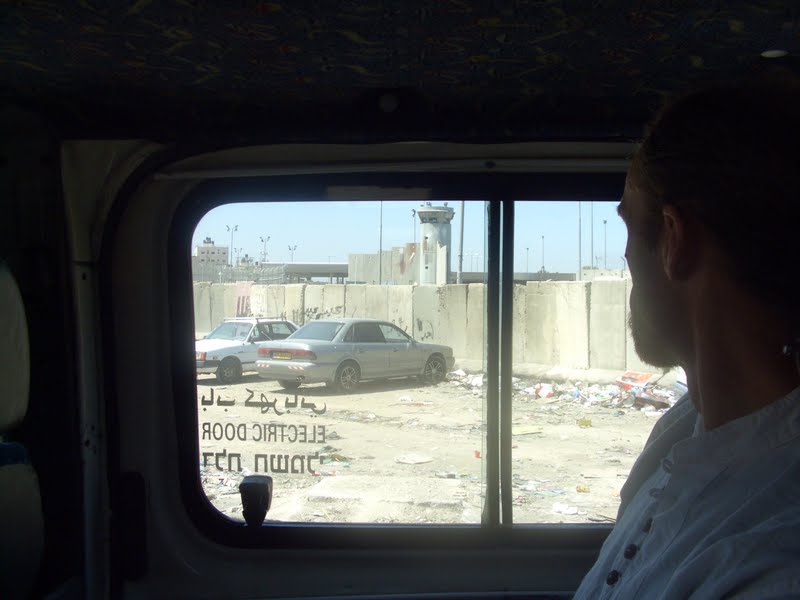
Qalandia checkpoint seen through the window of a minibus
The first weekend we went to visit a friend of my daughter’s who is the director of the Ramallah Museum.  He gave us a walking tour of Beit Reema and he showed us his new home that is under construction.  We had a wonderful dinner with his family and even helped his family celebrate his daughter’s ninth birthday.

Beit Reema
Last night, we heard a very unique and creative band that made music with all types of appliances and children’s learning devices. 


And I learned a new card game—two-handed euchre.

Q: What surprised you most about Palestine?

One thing was a wonderful welcoming surprise—the appearance of safety.  I call it an "appearance of safety" because it is an outward appearance…things seem to be safer than what I had imagined.  However, these guys are all walking around with weapons for a reason.  And things have happened in the news since I’ve been here.  I’ve heard sounds like gunfire at different times, but nobody else pays attention to it.

I was also surprised by how truly cosmopolitan Ramallah is.

Q: Have you felt safe traveling around Palestine?

Yes, I have. 

Q: Did you eat any new foods while in Palestine?

Oh yes.  I’ve eaten something called “ful.”  I’ve eaten something called “shwarma.”  And a few other new dishes.  At the birthday party in Beit Reema, we had special cake that the mother made, and we also ate some ‘sugared water balls’ while there, too.

Enjoying falafel in Old Jerusalem
Homemade birthday cake called "Lebanon nights"
One thing that I enjoyed the most were the grape leaves.

Q: What would you recommend a visitor do in Palestine?

First of all, I recommend that if a visitor has an interest to see the Biblical historical sites, the visitor should fully grasp the meaning of the area or what they’re looking at—they should do some research to understand the biblical history. 

Also, visitors should enjoy the people…enjoy the scenery.  Come with a nice camera.  Bring something with video to capture the sights.  What’s most exhilarating are the beautiful panoramic views.

Go to the Dead Sea—that’s what I enjoyed to most…especially the view.  I could see Jordan.
The Dead Sea (with Jordan in the background)
Learn a little Arabic—at least the general greetings, thank you, how much, pleasure to meet you… 

Q: What would you advise against?

I advise against being fearful and close minded.

Q: What about your trip will you still talk about one year from now?

My daughter and Mark and their beautiful home and being such gracious hosts.  And the egg breakfast that my daughter cooked.

Q: What are some things you’ve learned while in Palestine?

The one thing I’ve learned is how Americans have a lot of opportunities and freedom which unfortunately is not afforded to everybody in the world.  And sadly most Americans do not make the most of it.

I also learned that there is an abundance of multiple histories in this region.  I was aware of it to a certain extent, but I saw the strong influence of it with the Biblical (Christian) history, the Muslim, and the Jewish sites.  I also saw the strong investment and support that other countries have put in to preserve some of these sites.

Q: Are you taking back any souvenirs?

Yes.  A few simple mother-of-pearl items—some of the areas are known for mother-of-pearl.  A few simple handcrafted items made of olive wood—mostly bells because I like and collect bells.  Some Arabic coffee that has to be prepared in a special way (2-3 teaspoons boiled in a small pot for about 5 minutes) for a friend; and some spices—one special type of spice called Za’atar, which is a blend with thyme, coriander, sumac, and sesame seeds.  And some scarves.

Q: Anything you wish you had done that you don’t have time for?

I had read that this area was known for the baths and spas…so I wish I had found a good one and taken a day to relax at one of those.  Perhaps a Turkish bath.  It was not a high priority, but it was something I wanted to do and will do on another trip.  I would also like to see Tel Aviv.


Additional photos from Wanda's trip:
Sea of Galilee


A mini-bus - called a service - which is used for public transportation in Palestine

Water and wine in Cana
Town on the Sea of Galilee where Jesus preached
McDonalds in Tiberius
Wanda at the Jordan River